
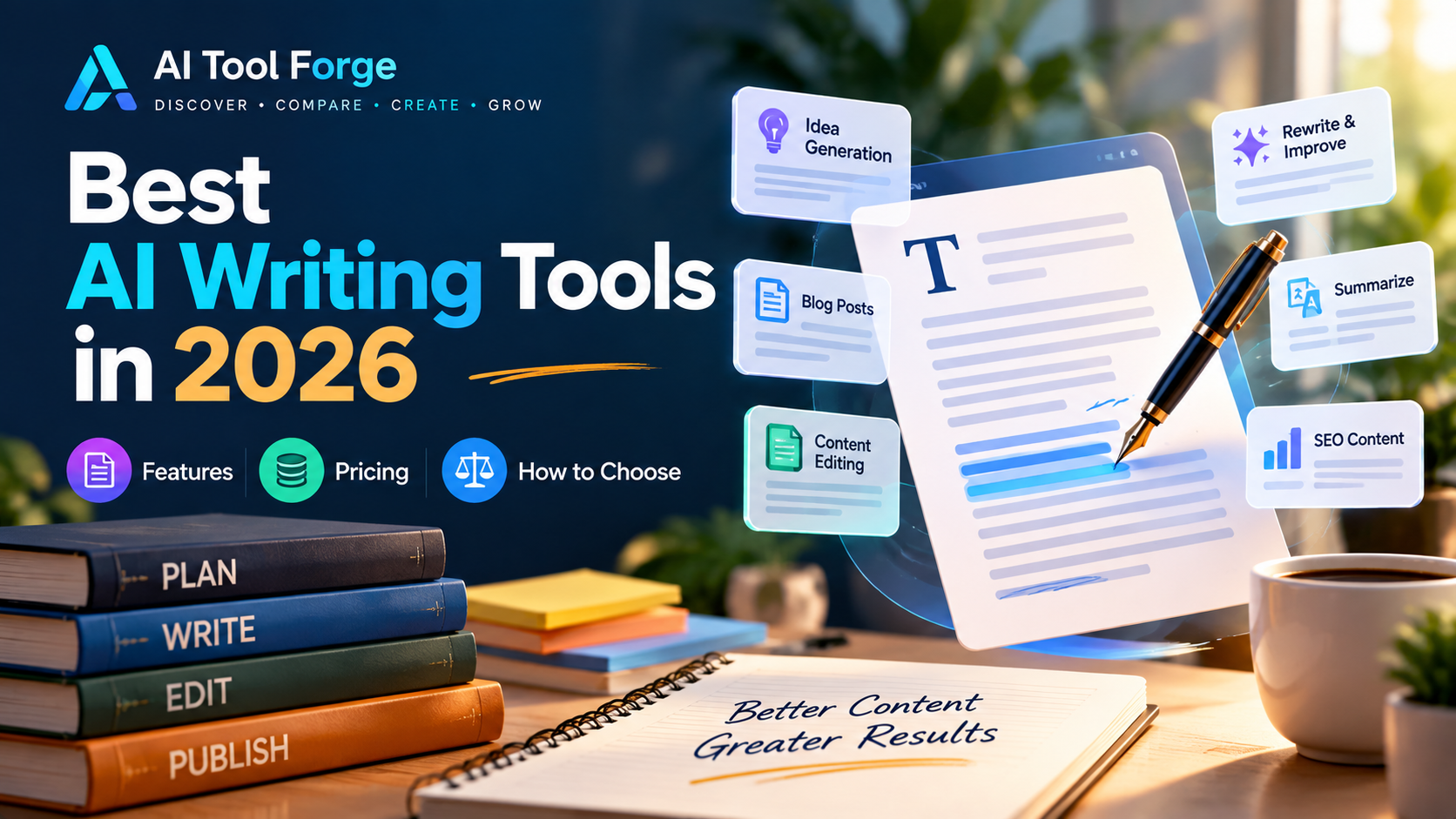
AI writing tools have become useful for much more than generating blog posts. Today, they can help with brainstorming, research, outlining, drafting, editing, rewriting, emails, marketing copy, product descriptions, and many other writing tasks.
But choosing the right AI writing tool is not always easy. Different tools are designed for different workflows, and the best option for a marketer may not be the right choice for a blogger, student, business owner, or content team.
In this guide, we’ll look at what makes an AI writing tool useful, how different tools compare, what features to consider, and how to choose an option that fits your needs and budget.
What Is an AI Writing Tool?
An AI writing tool uses artificial intelligence to help users create, improve, organize, or edit written content.
Depending on the platform, it may help with tasks such as:
- Writing blog posts and articles
- Creating outlines and content briefs
- Rewriting and improving existing text
- Writing marketing copy
- Creating social media content
- Drafting emails
- Generating product descriptions
- Summarizing information
- Correcting grammar and improving readability
However, not every AI writing tool is designed for the same purpose. Some are general-purpose AI assistants, while others focus on specific areas such as marketing, SEO, business communication, or long-form content.
What Makes a Good AI Writing Tool?
Before choosing a platform, look beyond the ability to generate text. A useful AI writing tool should fit the way you actually work.
Here are some of the most important factors to consider.
1. Writing Quality
The generated content should be clear, readable, and appropriate for the intended audience.
A good AI writing tool should also give you useful control over tone, style, structure, and length. However, AI-generated text may still require human editing to improve accuracy, context, and originality.
2. Ease of Use
A powerful tool can still be frustrating if its interface is complicated.
Look for a platform that makes it easy to create content, edit generated text, organize projects, and access the features you actually need.
3. Content Editing
Writing is only part of the process. Editing features can be just as important.
Useful capabilities may include rewriting, shortening, expanding, improving clarity, changing tone, and correcting grammar. These features can make an AI writing tool useful for both creating new content and improving existing drafts.
4. Templates and Workflows
Some AI writing platforms provide templates for common tasks such as blog introductions, advertisements, emails, product descriptions, and social media posts.
Templates can save time when you regularly create similar types of content. More advanced platforms may also offer workflows that help organize several steps of a content process.
5. Research and Accuracy
AI-generated content should not automatically be treated as fact.
For articles involving current information, statistics, product specifications, pricing, or other factual claims, information should be checked against reliable and up-to-date sources.
This is especially important when publishing content for search engines or making recommendations to readers.
6. Pricing and Value
Price is another important consideration, but the cheapest tool is not always the best value.
Compare the features you actually need with the tool’s pricing model, usage limits, and available plans. Some platforms use subscriptions, while others may use credits, usage limits, or different pricing structures for individual users and teams.
A more expensive platform may be worthwhile for a professional content workflow, while a simpler tool may be enough for occasional writing.
Popular AI Writing Tools to Consider
The AI writing market includes both general-purpose AI assistants and specialized platforms built for content, marketing, and business workflows. The right choice depends on the type of work you do, the features you need, and how often you use the tool.
ChatGPT
ChatGPT is a general-purpose AI assistant that can help with brainstorming, outlining, drafting, rewriting, summarizing, editing, and many other writing tasks.
Best for: General writing, brainstorming, research assistance, editing, and flexible content workflows.
Official website: ChatGPT
Jasper
Jasper is focused more heavily on marketing and business content. Its workflow-oriented approach can be useful for teams that need structured content processes and brand-focused writing.
Best for: Marketing teams, businesses, and structured content workflows.
Official website: Jasper
Copy.ai
Copy.ai focuses on AI-assisted business and marketing workflows. It can be useful for creating different types of business content and automating parts of a content process.
Best for: Marketing, sales, and business content workflows.
Official website: Copy.ai
Writesonic
Writesonic provides AI-powered tools for content creation and related marketing tasks. It may be useful for users who want a more structured platform for producing online content.
Best for: Bloggers, marketers, and content teams.
Official website: Writesonic
Bonus: PopAI AI Sheets
PopAI AI Sheets is an AI-powered spreadsheet workspace designed to help users work with structured data, documents, and research. It can turn natural-language instructions into spreadsheet formulas, organize information from PDFs and CSV files, combine web research with document data, and generate reports from structured information. It also supports exporting results for use with Excel and Google Sheets. AI Sheets
Best for: Research, data organization, spreadsheet automation, business reports, and users who work with large amounts of structured information.
If your writing workflow involves research, product comparisons, data analysis, or creating reports from documents, an AI spreadsheet tool can complement a traditional AI writing assistant.
Try PopAI AI Sheets: PopAI AI Sheets
This link is an affiliate link. If you purchase through it, AI Tool Forge may earn a commission at no additional cost to you.
How to Compare AI Writing Tools
Instead of asking which tool is universally the best, compare each option based on your own requirements.
Consider:
- The type of content you create
- Writing and editing features
- Research capabilities
- Templates and workflows
- Brand or tone controls
- Usage limits
- Integrations
- Pricing and billing structure
- Whether you need individual or team features
- How much human editing you expect to do
A general-purpose AI assistant may be enough for occasional writing and brainstorming, while a specialized platform may make more sense for a professional marketing or content workflow.
AI Writing Tools for Different Needs
The best AI writing tools depend on what you want to accomplish. Instead of choosing a tool simply because it is popular, consider how well its features match your workflow.
For General Writing and Brainstorming
General-purpose AI assistants can be useful for brainstorming ideas, creating outlines, rewriting text, explaining concepts, and developing different types of written content.
For Marketing Content
Marketing-focused platforms can be useful for advertisements, campaign copy, sales content, email marketing, and brand messaging. Features such as templates, brand controls, and structured workflows can be especially useful for marketing teams.
For Blog and SEO Content
Bloggers and content publishers may want tools that support outlining, long-form drafting, editing, research, and content optimization. When using AI for SEO content, factual accuracy and human editing remain important.
For Business and Team Workflows
Businesses and content teams may need more than text generation. Collaboration, brand consistency, workflow management, integrations, usage controls, and administrative features can become important when several people use the same platform.
For Research and Data-Heavy Work
If your work involves spreadsheets, documents, structured data, or research, a specialized AI tool may complement a traditional writing assistant. PopAI AI Sheets, for example, is designed around AI-assisted spreadsheet and data workflows rather than traditional content writing.
AI Writing Tools vs. Human Writers
AI writing tools can save time, but they do not eliminate the need for human judgment.
AI can help with brainstorming, drafting, restructuring, summarizing, and editing. However, important content should still be reviewed by someone who understands the subject, context, and intended audience.
Human review is particularly important when an article includes factual claims, recommendations, technical information, or details that may change over time.
For most professional content workflows, the strongest approach is often a combination of AI assistance and human editing.
What Should You Check Before Choosing?
Before subscribing to one of the many AI writing tools available today, consider how well it fits your actual workflow.
Ask yourself:
- What type of content do I create most often?
- Do I need long-form writing or short-form copy?
- Does the tool support the writing style and tone I need?
- How easy is it to edit and refine AI-generated content?
- Does it offer useful templates or workflows?
- Does it provide research or information-retrieval features?
- Can I use it without unnecessary complexity?
- Does the pricing model make sense for my actual usage?
- Are there limits on features, usage, or integrations?
- Do I need individual, collaboration, or team features?
- What are the tool’s privacy and data-handling policies?
The best choice is not necessarily the tool with the most features. It is the one that provides the capabilities you actually need at a reasonable overall cost.
Our Approach to Reviewing AI Writing Tools
At AI Tool Forge, we focus on practical usefulness rather than simply listing features.
When evaluating an AI writing tool, we consider factors such as:
- Features and functionality
- Ease of use
- Writing and editing capabilities
- Research and information-retrieval features
- Workflow and productivity
- Pricing and usage limits
- Strengths and limitations
- Suitable use cases
We also look at who a tool is best suited for—and who may not need it. A platform with many advanced features is not automatically the right choice for every user.
Our goal is not to claim that one tool is the best for everyone. Instead, we aim to provide useful, clear, and balanced information so readers can make a more informed decision.
Where pricing, features, or other details may change, we recommend checking the provider’s official website before making a purchase or subscription decision.
Final Thoughts
There is no single AI writing tool that is perfect for everyone.
The right choice depends on your goals, workflow, budget, content requirements, and how much control you want over the writing process.
General-purpose AI assistants can be useful for brainstorming, drafting, and everyday writing, while specialized platforms may offer more structured workflows for marketing, SEO, business, or content teams. Tools such as AI-powered spreadsheet platforms can also complement writing workflows when research and data are involved.
Before choosing a tool, compare its features, usage limits, pricing structure, and suitability for your actual needs rather than relying only on popularity or marketing claims.
Explore. Compare. Choose with confidence.